What a 3D print really costs: filament, power, wear and your time
The parts that make up the cost of a print, how to work each one out, and why your own time usually costs more than the plastic.
Updated 2026-11-05
Short answer
The filament in a small print usually costs less than a coffee. What makes a print expensive is everything around it: the hours on the printer, the parts that wear out, the prints that fail, and the minutes you spend removing, cleaning, checking and packing it. If you only count filament, you will set prices that lose money as soon as you sell more than a few.
This guide goes through each part of the cost and shows a worked example. The print cost calculator does the sums for you once you have your own numbers.
1. Filament
Your slicer shows how many grams a print uses. Multiply that by the price you pay per gram: a 1 kg spool at 20 euros costs 2 cents per gram. Include the purge waste of multi-color prints, which can be larger than the part itself on a small model, and the brim or supports.
For a rough idea before you slice, here are the solid weights of a few default models on this site. Solid means 100% infill. A normal print with a few walls and 15% infill weighs noticeably less, so treat these as an upper limit.
- Zipper pull: about 2 g (solid weight, measured from the default model).
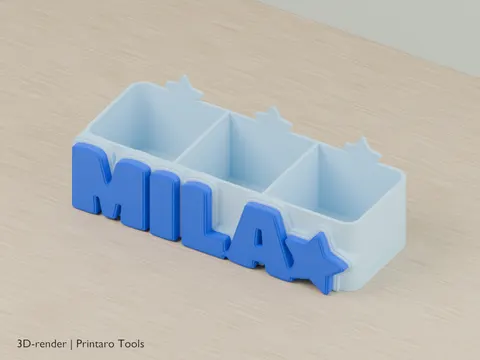
- Name keychain: about 5 g.
- Cookie cutter: about 4 g.
- Christmas ornament: about 16 g.
- Name dragon: about 35 g.
- Coaster: about 37 g.
- Gridfinity bin, 2 × 1: about 46 g.
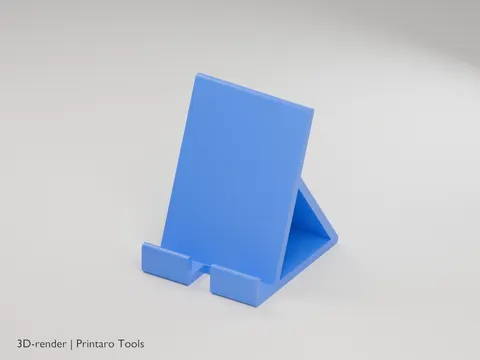
- Phone stand: about 104 g.
- House number sign: about 110 g.
- Name pen holder: about 118 g.
2. Electricity
Power cost is the printer's average power in kilowatts × hours × your price per kWh. The number on the spec sheet is the maximum, not the average: Bambu Lab lists the A1 at up to 1300 W at 220 V, but that peak only lasts while the bed heats up. While it prints PLA, a printer of this size draws far less. A plug-in power meter between the socket and the printer shows your real average after one long print.
As an example, a printer that averages 100 W for a 4-hour print uses 0.4 kWh. At 30 cents per kWh that is 12 cents. Electricity matters more for ABS and ASA, which need a hot bed and an enclosure, and for long prints on a large bed.
3. Wear parts and the printer itself
Parts wear with every hour of printing. Bambu Lab's maintenance guide for the A1 replaces the PTFE tube every 6 spools of PLA and similar materials, and every 2 spools of carbon-fiber filament. It asks you to check the filament cutter every 3 spools and replace the hotend when it is worn or leaks. Build plates lose their grip over time. Add up what you spend on such parts in a year and divide it by the hours you print, and you have a cost per hour.
The printer itself wears out too. Divide what you paid by the hours you expect to print before you replace it. A 400-euro printer that lasts 2,000 printing hours costs 20 cents per hour, before any repair. If you print a lot, this number is real money, and it is the one people most often forget.
4. Failed prints
Not every print succeeds. Spaghetti, a part that comes loose, a color swap that went wrong or a customer's name spelled wrong all cost filament and time. Keep a simple tally for a month: how many prints you started and how many you could sell. If one in ten fails, add 10% to the filament, power and wear of every print.
5. Your time
The printer works by itself, but you don't. Count the minutes per item for preparing the file, starting the print, taking it off the plate, removing supports or brims, checking it, and packing it. Answering the customer's questions counts too. Five minutes here and ten there quickly add up to a quarter of an hour per order.
Decide what an hour of your time is worth, even if this is a hobby. If you leave it out, every sale looks profitable, and you only notice the problem when you are busy.
A worked example
The numbers below are examples, not prices you will pay. Replace them with yours. Take a part that the slicer says uses 80 g and prints in 4 hours.
- Filament: 80 g at 2 cents per gram = 1.60 euros.
- Electricity: 0.4 kWh at 30 cents = 0.12 euros.
- Wear parts: 10 cents per hour × 4 hours = 0.40 euros.
- Printer: 20 cents per hour × 4 hours = 0.80 euros.
- Failed prints: 10% of the above = 0.29 euros.
- Your time: 15 minutes at 20 euros per hour = 5.00 euros.
- Total: about 8.20 euros, before packaging, shipping and selling fees.
What the example shows
The filament is less than a fifth of the cost, and your time is more than half. That is typical for small items. It also shows where you can save: printing several items on one plate shares the handling time between them, and a design that needs no supports or brim saves minutes on every piece.
Once you know the cost, the next step is the price. How to price 3D prints covers margins, selling fees and what buyers will pay, and the profit calculator shows what you keep at a given price.
Frequently asked questions
Is filament the biggest cost of a 3D print?
Usually not. For small items your own handling time costs more than the plastic. Filament becomes the biggest part only for large, heavy prints that need little handling.
How do I know how much power my printer uses?
Put a plug-in power meter between the socket and the printer and read the average after a long print. The maximum on the spec sheet is only reached while the bed heats.